Biscayne Bay Weather by Season: Temps, Wind & Traffic Guide
Biscayne Bay Weather by Season: Monthly Temps, Wind & Boating Patterns
Understanding Biscayne Bay weather by season is important before planning time in Miami. Seasonal shifts in humidity, wind direction, rainfall, and temperature directly affect water comfort, visibility, and overall conditions on the bay.
Throughout the year, currents change, boating traffic fluctuates, and wildlife activity adjusts to seasonal patterns. Some months bring calmer water and clearer skyline views, while others are known for higher heat, afternoon storms, or increased activity on the water.
This guide explains Biscayne Bay weather by season, helping you understand what to realistically expect during different times of the year based on established climate trends and local conditions.
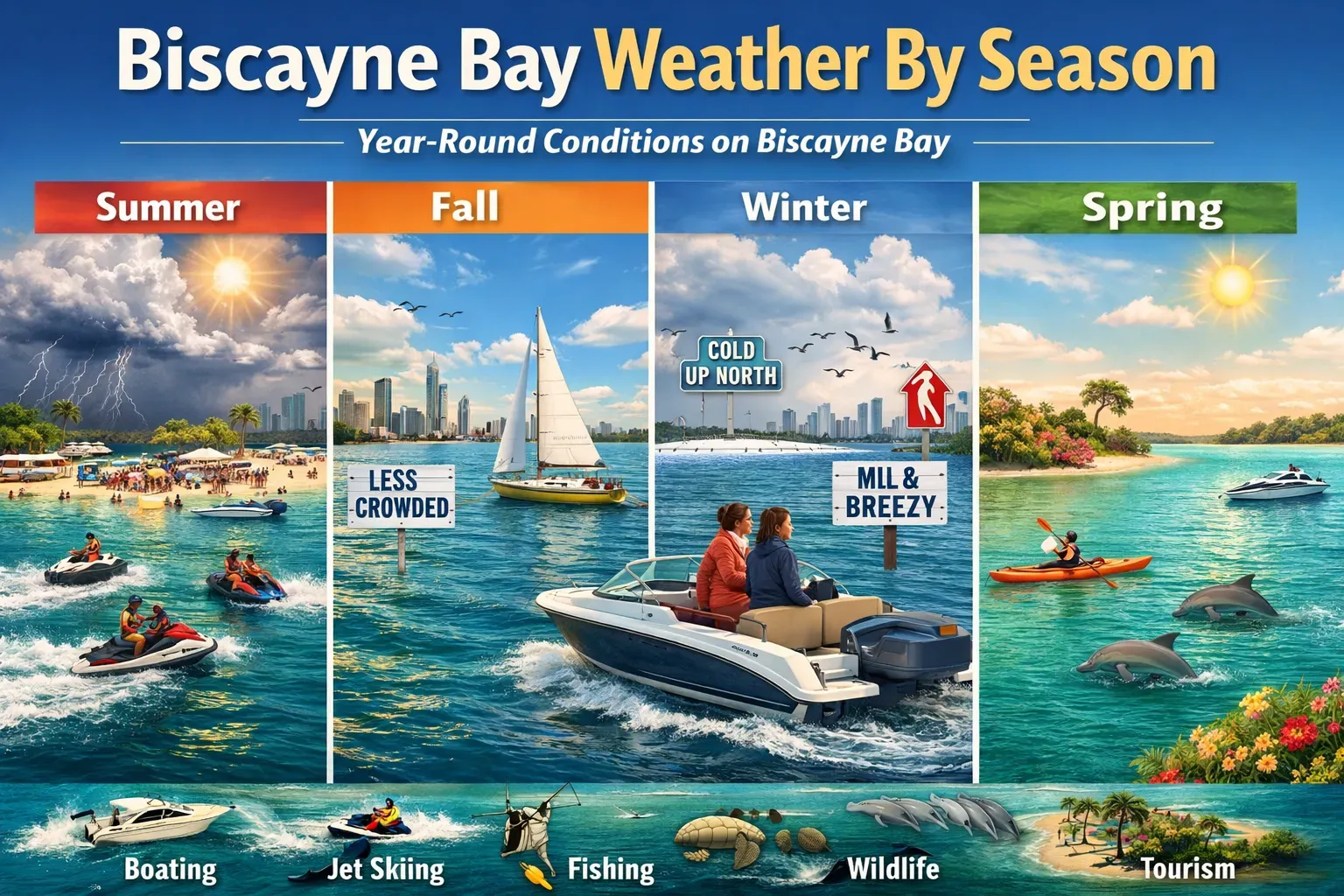
How Seasonal Weather Affects Biscayne Bay Water Conditions
Seasonal shifts directly influence Biscayne Bay water conditions throughout the year. Temperature, rainfall, humidity, and wind patterns change noticeably between winter and summer months.
January – March
- Average daytime temperatures: 70–78°F
- Lower humidity levels
- Reduced rainfall compared to summer
- Passing cold fronts occasionally increasing wind
- Clearer air following frontal systems
April – June
- Temperatures rising into the 80s
- Humidity steadily increasing
- Mostly dry mornings
- Thunderstorm patterns beginning in late May
- More variable afternoon wind conditions
July – September
- Average daytime temperatures: 88–92°F
- Highest humidity levels of the year
- Frequent afternoon thunderstorms
- Sudden wind shifts before storms
- Warmest surface water temperatures
October – November
- Noticeable drop in humidity
- Reduced rainfall compared to peak summer
- Fewer afternoon storms
- More consistent wind patterns
- Improved atmospheric clarity
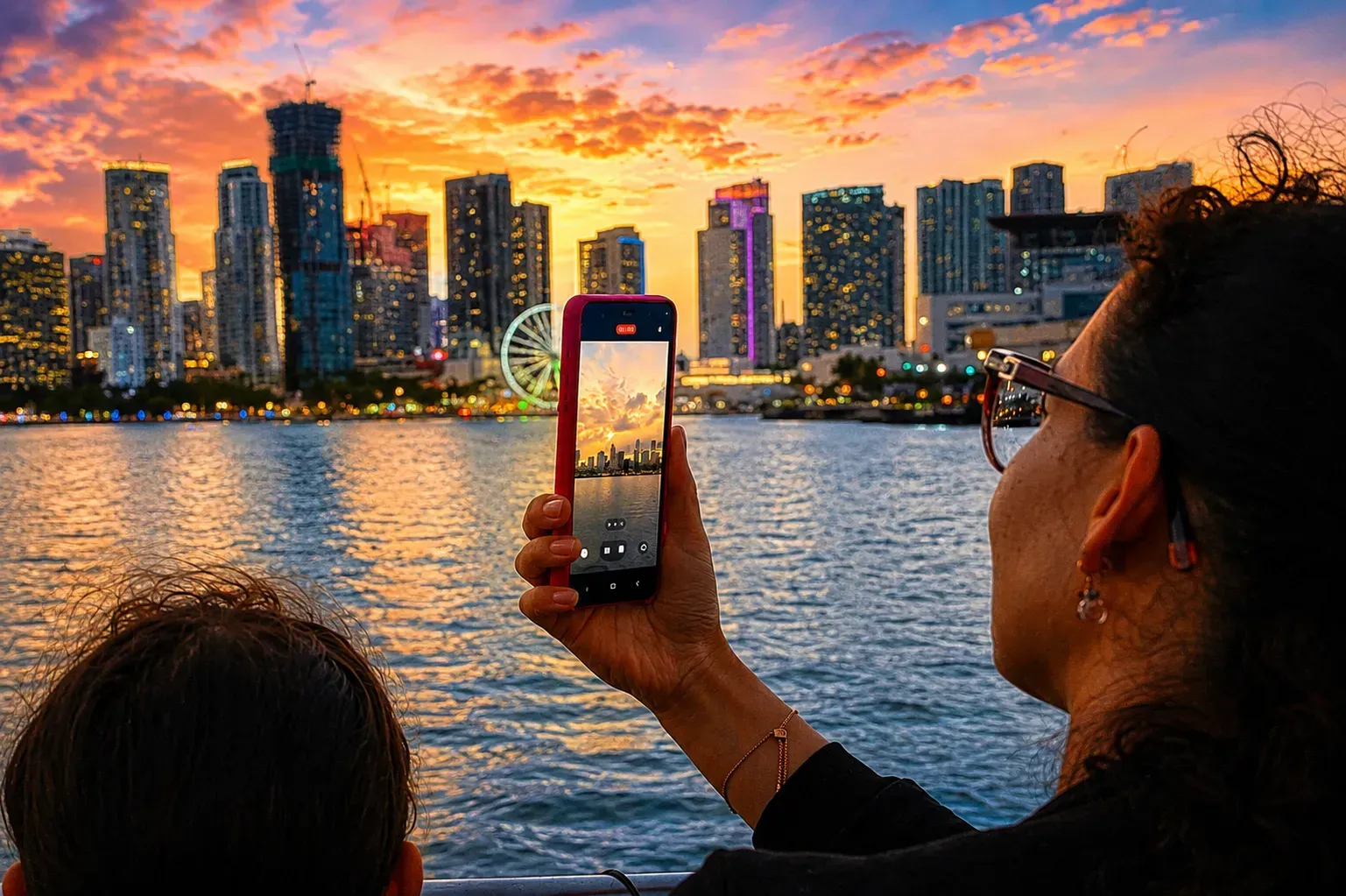
For sunset visibility in particular, October and November often provide some of the clearest skies of the year. Slightly cooler air and lower moisture levels reduce haze, allowing for sharper skyline views and more vibrant evening light conditions.
These monthly transitions explain why water clarity, comfort, and overall visibility vary depending on the season.
For those planning time during optimal conditions, seasonal awareness can help when selecting sightseeing experiences around Biscayne Bay.
Monthly Water Temperatures in Biscayne Bay
Water temperatures in Biscayne Bay stay warm compared to most coastal regions, but local perception varies depending on the time of year.
January – March
- Average water temperature: 72–75°F
- Considered “cool” by many Miami residents
- Still warmer than summer water in many parts of Europe
- Fewer swimmers compared to peak summer months
For visitors from colder climates, these temperatures often feel comfortable. For locals, it can feel brisk — especially after a passing cold front.
April – June
- Average water temperature: 76–82°F
- Gradual warming through late spring
- Comfortable for extended time in the water
- Stable morning conditions before summer storm patterns begin
This period is often viewed as a transition phase — warming, but not yet at peak summer intensity.
July – September
- Average water temperature: 84–87°F
- Warmest water of the year
- Highest humidity levels
- Peak beach traffic across South Beach, Miami Beach, North Beach, Surfside, Sunny Isles, and Hallandale
- Strong demand for umbrellas and rentals during this period
These months are commonly associated with classic “Miami beach weather,” when both water and air temperatures remain consistently high.
October – December
- October water temperatures: 80–82°F
- Gradual cooling into 74–77°F by December
- Noticeable drop in humidity beginning mid-October
- Less rainfall compared to peak summer months
As the air cools slightly and moisture levels decrease, overall comfort improves, especially in late October and November.
Even small seasonal shifts in water temperature influence swimming comfort, beach activity, and boating patterns throughout the year.
Wind Patterns and Surface Conditions in Biscayne Bay
Wind plays a major role in how Biscayne Bay surface conditions feel on any given day. Even when temperatures stay consistent, changing wind direction can quickly affect water smoothness.
December – March (Cold Front Season)
- Cold fronts move through South Florida every few weeks
- Winds often shift from south or east to north or northwest
- The day after a front passes can feel noticeably breezier
- Short periods of choppier water are more common
- Air becomes clearer after fronts, improving visibility
These months bring the biggest swings between calm and breezy days.
April – June (Transition Period)
- Fewer strong cold fronts
- More consistent east or southeast winds
- Mornings are usually calmer
- Light surface texture increases after midday
Water conditions tend to be more predictable during this period.
July – September (Summer Sea-Breeze Pattern)
- Daily sea breeze builds as land heats up
- Winds increase between late morning and mid-afternoon
- Afternoon thunderstorms can create sudden gusts
- Early mornings are typically the calmest part of the day
Water may look smooth at 9 AM and noticeably more textured by 2 PM.
October – November (Stabilizing Conditions)
- Thunderstorm frequency drops compared to peak summer
- Humidity begins to decrease
- Wind direction becomes more steady
- Early mornings often provide the smoothest surface conditions
This period is generally more stable than winter cold-front season.
Time of Day Matters
- Sunrise to late morning: typically the calmest window
- Midday to afternoon: sea breeze increases surface movement
- Before storms: sudden wind shifts are possible
Biscayne Bay connects to protected marine areas managed within Biscayne Bay National Park, where seasonal weather and tidal movement also influence ecosystem conditions.
Crowd Patterns and Boating Traffic in Biscayne Bay
Boating activity in Biscayne Bay follows local weather patterns more than traditional tourism cycles. Water temperature, school breaks, and major holidays influence how active the bay feels throughout the year.
January – February
- Moderate boating activity
- Cooler water temperatures limit extended swimming
- Fewer large sandbar gatherings
- Weekends slightly busier than weekdays
- Generally manageable traffic levels
These months are active but not overcrowded.
March (Spring Break Window)
- Noticeable spike during Spring Break weeks
- Increased vessel traffic near popular sandbars
- Higher beach attendance across Miami Beach and surrounding areas
- More personal watercraft activity
Outside of Spring Break, early March remains moderate.
April – June
- Gradual increase in boating traffic
- Warmer water temperatures draw more swimmers
- Memorial Day weekend marks a major activity spike
- Longer daylight hours increase afternoon boat volume
Traffic builds steadily as summer approaches.
July – September (Summer Peak on the Water)
- Warmest water temperatures of the year
- Strong local boating presence
- High beach attendance across South Beach, Sunny Isles, Surfside, and surrounding areas
- Major holidays driving heavy traffic:
- Fourth of July
- Labor Day Weekend
- Increased sandbar and nearshore activity
These months are often considered prime “in-the-water” season due to heat and water warmth, but they are also the busiest.
October – November
- Noticeable drop in boating volume
- Reduced humidity and fewer thunderstorms
- More open water space
- Calmer weekends compared to summer
This period often feels significantly less congested.
December
- Early December remains relatively calm
- Traffic increases during Christmas and New Year’s week
- Holiday waterfront events draw localized activity
Outside of the holiday window, December is typically manageable.
What to Expect on Biscayne Bay Throughout the Year
No matter the month, activity on Biscayne Bay remains consistent. What changes is intensity — not presence. Understanding Biscayne Bay weather by season helps explain those shifts.
Throughout the year, the bay supports:
- Recreational boating
- Personal watercraft activity
- Fishing and marine exploration
- Waterfront tourism
- Seasonal wildlife movement
Some months bring heavier vessel traffic and busier sandbar gatherings. Others offer more open navigation space and calmer weekday conditions. Rainfall patterns fluctuate, wind shifts occur, and water temperature rises and falls — but access to the bay remains steady.
Because of South Florida’s climate, Biscayne Bay weather by season does not follow extreme northern patterns. There is no deep freeze period or extended shutdown. Even during cooler months, marine life remains active and water access continues.
Rain is part of the seasonal cycle. Afternoon thunderstorms are common in summer, while frontal systems influence winter wind patterns. Yet between these shifts, clear skies and stable conditions return quickly.
Across all twelve months, the bay supports:
- Jet skiing
- Fishing
- Wildlife viewing
- Recreational cruising
- Waterfront activity
While seasonal timing influences crowd density and surface conditions, the overall experience remains dynamic year-round.
When viewed through the lens of Biscayne Bay weather by season, what stands out is not extreme fluctuation — but continuity. The bay stays active, navigable, and visually striking in every season.
Among coastal regions in the United States, few bodies of water maintain this level of year-round accessibility and environmental diversity.
How Biscayne Bay Weather by Season Shapes Year-Round Conditions
When analyzing Biscayne Bay weather by season, consistent patterns emerge that influence surface movement, water temperature, boating density, and overall comfort levels.
Unlike inland climates, Biscayne Bay weather by season is shaped by maritime airflow, Atlantic pressure systems, and South Florida’s subtropical positioning. Seasonal changes are gradual, but measurable.
From January through March, frontal passages introduce variability in wind direction and short-term surface texture. By late spring, humidity rises and sea-breeze cycles strengthen. During peak summer, water temperatures reach their highest levels while afternoon convection becomes more frequent. After September, both atmospheric moisture and vessel congestion begin to taper.
What defines Biscayne Bay weather by season is not extreme fluctuation, but controlled variation. Access remains constant, while intensity shifts in predictable cycles.
Over a twelve-month calendar, Biscayne Bay weather by season reflects stability compared to most U.S. coastal regions. There is no dormant period. There is no shutdown phase. Instead, conditions rotate between higher density and more balanced intervals.
Understanding these seasonal rotations allows for more precise expectations about water clarity, surface movement, and boating traffic — all of which are directly influenced by Biscayne Bay weather by season.
How Biscayne Bay Weather by Season Affects Marine Wildlife
Seasonal shifts in Biscayne Bay weather by season influence not only water conditions and boating activity, but also marine and bird life throughout the year.
Bottlenose Dolphins
Biscayne Bay is home to resident populations of Atlantic bottlenose dolphins. These dolphins remain in South Florida waters year-round, but their feeding patterns shift with seasonal fish movement.
- Warmer months increase baitfish activity
- Calm mornings often improve dolphin visibility
- Feeding behavior is more common near tidal transitions
While dolphins can be seen in every season, clearer post-front conditions in cooler months can improve surface visibility.
Manatees
The West Indian manatee is a protected species frequently observed in Biscayne Bay.
- During cooler winter periods, manatees seek warmer waters near natural springs, power plant outflows, or shallow protected zones
- In warmer months, they disperse throughout the bay
- Feeding activity increases in seagrass-rich areas
Manatees are protected under federal and Florida law. Harassment, feeding, or giving freshwater to manatees is prohibited and enforceable by the Florida Fish and Wildlife Conservation Commission (FWC).
Seasonal water temperature changes directly influence their movement patterns.
Stingrays and Tarpon
Biscayne Bay supports a variety of species including:
- Southern stingrays
- Cownose rays
- Tarpon
Warmer months increase surface activity and visibility, particularly in shallower areas. Stingrays are sometimes observed breaching the surface during feeding or migration behavior.
Tarpon are more active during warmer seasons when baitfish concentrations increase.
Fish Populations
Seasonal temperature shifts affect:
- Snapper
- Grouper
- Mullet
- Baitfish schools
Higher summer water temperatures increase fish metabolism and feeding cycles. Winter fronts can temporarily shift distribution patterns, especially in shallower zones.
Bird Activity
Biscayne Bay supports diverse bird life year-round, including:
- Brown pelicans
- Seagulls
- Ospreys
- Herons and egrets
Bird feeding activity often increases during tidal changes and periods of active fish movement. Seasonal clarity and wind patterns can influence how easily wildlife is observed from the surface.
Seasonal Ecosystem Impact
Because Biscayne Bay weather by season influences water temperature, wind patterns, and tidal movement, wildlife behavior adjusts accordingly.
Unlike regions with freezing winters, marine ecosystems in Biscayne Bay remain active year-round. Seasonal shifts influence distribution and visibility — not presence.
Final Perspective on Biscayne Bay Weather by Season
Across the calendar year, Biscayne Bay weather by season shapes more than surface conditions. It influences marine life movement, boating density, water temperature, and overall activity levels.
Summer brings warmer water and increased traffic. Fall introduces a measurable slowdown after September. Winter shifts wind direction and cooling patterns. Spring transitions gradually back toward peak water season. Throughout these cycles, wildlife remains active and the bay stays navigable.
Unlike regions with defined off-seasons, Biscayne Bay operates in seasonal adjustments rather than shutdowns. Conditions evolve — they do not disappear.
Understanding Biscayne Bay weather by season provides clarity on what to expect, whether evaluating water warmth, surface texture, wildlife visibility, or boating activity. The bay remains dynamic twelve months a year, with variation driven by climate patterns and regional behavior — not extremes.
That continuity defines Biscayne Bay.